The Morning Avalanche
Why the HSP Soul Sometimes Chooses the Shadow

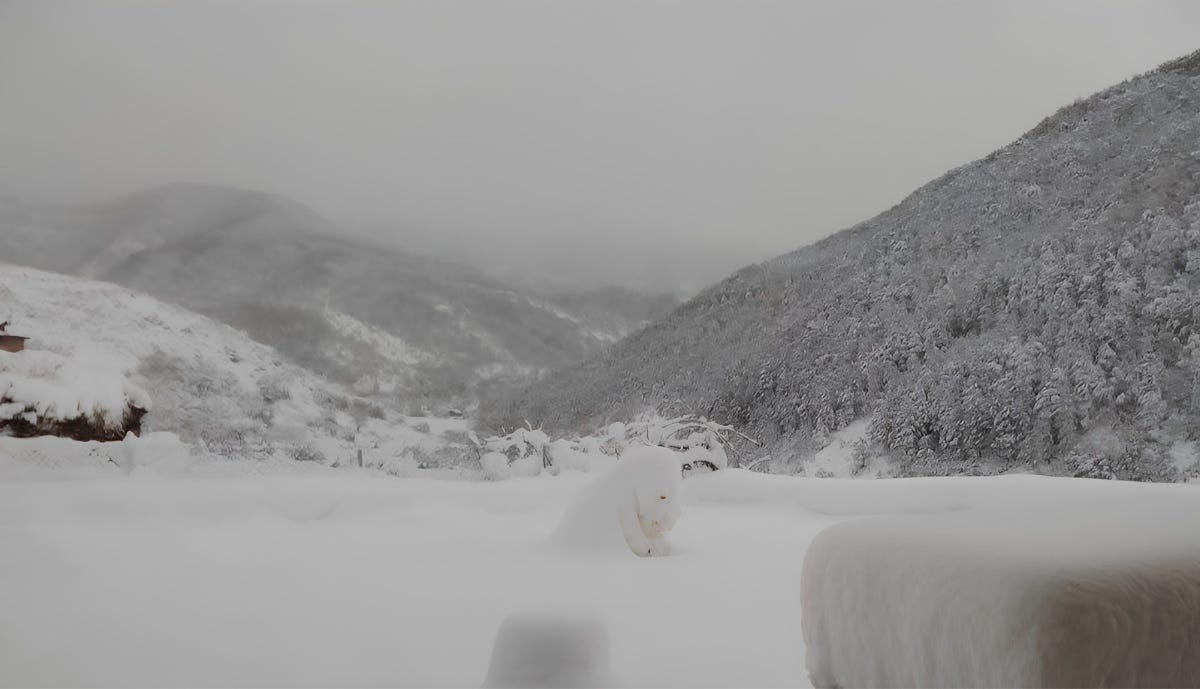
Sometimes I just know it’s one of these mornings. Still lying in bed, even before I open my eyes, I can almost feel it roll over me: a silent, invisible, yet leaden avalanche of something. No specific thought, no pain or aching need – just a threatening, nameless darkness. And my immediate reaction: I don’t want this. Make it go away.
Tug-of-War
Then the tug-of-war begins. On the left, my Inner Teacher pulls with the weight of expertise. She starts rationalizing the situation:
Your colitis is back, and 90-95% of serotonin is produced in your gut brain – no wonder you’re having a mood drop.
Then she goes on to list emotion regulation strategies and somatic tools:
Calm your breath. Why don’t you go and meditate? You should do some yoga, that’ll be good for you.
Pitting against her from the right, my Inner Critic yanks the rope with the cold force of shame:
Get it together! Don’t just sit there bathing in self-pity. You’re an adult now, you’re a coach! Act like it.
And the rope itself? That’s my inner five-year-old. Who doesn’t want any of this, doesn’t want to hear explanations, doesn’t want to have to fix anything or pull herself together. But most of all she doesn't want to be torn apart.
So temporarily, the Inner Critic gets the upper hand. I get up, I sit in front of my computer, trying to switch on “productive mode.” But the avalanche shows no sign of loosening its firm, asphyxiating grip on me.
The Bluest of Prints for Connection
So I pause.
I close my eyes, and then I do nothing.
In that stillness, the opponents fall silent too – and Little Susi relaxes a little. As everyone is quiet, the tension in the rope drops. But the sadness stays.
An image pops up in my head, a chubby, blue character with a shimmery bob, puppy eyes and big round glasses. “Sadness” (from Disney’s Inside Out) epitomizes a childhood pattern I’m still working on today: In the movie, she is presented as a vital catalyst for closeness, and therefore comfort and safety. In my childhood, while these expressions of love were never lacking in our family, they used to be most evident whenever one of us was in a crisis. There seemed to be this unspoken golden rule: When one of us is suffering, we drop everything and are there for them. And although this rule turned out to be a pillar of my basic sense of trust in the world, it also created a deep, problematic neurological imprint: Sadness brings me love. Even today, some of my strongest memories of profound connection with friends and family are from moments of crisis, and I tend to feel especially drawn to people who embrace vulnerability: Part of my brain still views pain as the most reliable bridge to profound connection, and we HSPs crave profound connection.
The Reptile at the Rope
So “Sadness” isn’t the villain. She is the expression of a natural need for being held, and for five-year-old Susi, the Inner Teacher’s “explaining” or “regulating” her away isn’t helpful – it threatens to take away her voice.
But why is the Teacher trying to anyway? Why won’t she just leave Sadness be? While it is no mystery that our human tendency to categorize everything into positive and negative has led to sadness being labelled as undesirable, this doesn’t quite explain why it should feel like a threat. The answer lies in Attachment Theory: When our reptile brain is forced into fight-flight-or-freeze mode, it is usually due to a sense of danger to a very basic need, like that of attachment. In my case, this is rooted in experience from a deeply unbalanced relationship (a dynamic that felt even more destabilizing while I was navigating life far from home) where “negative” feelings systemically led to rejection and even aggression. My ex-partner – highly sensitive himself, but untrained in regulating his emotions and therefore frequently overpowered by them – was unable to avoid absorbing other people’s moods as his own and therefore tended to subconsciously punish me for “pulling” him down.
In Jungian terms, my ex was the Shadow of my upbringing. Where my family was an ocean of Enmeshment (shared emotion), he was a fortress of isolation. Choosing him was a brutal form of Individuation, a “disconfirming experience” that shattered the belief that suffering was the most reliable bridge to connection. It forced a software update: I had to learn how to dig myself out of the avalanche with my own hands because, for the first time, there was no one there with a shovel.
Hugging the Snow
But knowing how to dig yourself out doesn’t mean the snow isn’t cold anymore. In moments of overwhelm, I still often find myself torn: Little Susi needs Sadness as a social glue, while Adult Susi has come to fear it as a social landmine.
And yet, I also know that I am not either one of them, I am both – but I have also grown beyond both of them, and I can step out of any tug-of-war. As a highly introspective human being with deep processing skills, practising the Buddhist concept of non-attachment and radical acceptance, I have gotten better at appreciating the full spectrum of emotions as the essence of this wonder that is the human experience.
And I am the partner of a wonderful human being who manages to strike the balance when my Inner Tug-of-Warriors won’t let me: neither absorbing nor rejecting my feelings, neither magnifying nor minimizing them, but simply being there, providing space for resonance, and helping me “hug the snow” (bringing me chocolate as I write this – you know, to help with the serotonin). And as we work together in this way to help Little Susi see Sadness as a presence just as valid as all her other emotions, she finds the warmth she needs to soften. She doesn’t have to melt away to make room for brightness, but in being held, she naturally loses her icy edge.
We don’t have to melt away the sadness to make room for brightness. We just have to embrace the snow and look at it from an angle where it glistens in the sun. And suddenly we realize that the most beautiful light is the kind that can be found right in the middle of the cold.

A Note to the Reader
I would love to hear how this resonates with you. Do you recognize your own version of the “Morning Avalanche,” or that internal tug-of-war between the Teacher and the Critic? How do you hold space for yourself when the snow feels heavy?
Please feel free to share your thoughts in the comments below. Let’s create a space where these “Blueprints” can be seen and understood together.
Deepen Your Understanding:
The Gut-Brain Axis: How your digestive system (your "second brain") influences mood and serotonin production.
Understanding Enmeshment: A look at family systems where emotional boundaries are blurred and how it affects adult relationships.
Jungian Shadow Work: An introduction to the Shadow and how Individuation helps us become whole.
Attachment Theory & The Nervous System: Why our "reptile brain" reacts to emotional signals from our partners as matters of survival.
Radical Acceptance: A guide to the Buddhist-inspired practice of accepting reality as it is, without judgment.